Some of you may recall this post I wrote not about a month ago:
Tale of a Mundane Nature
The correspondence continued with this woman to the point where we decided to get together yesterday and record a performance since I wouldn't be able to perform it at her actual class.
So yesterday the woman came over, bringing her young child which was perfect for my son as he now had a play partner so mommy could entertain. What I didn't know was that she wanted to record and interview with me, so she gave me the questions to look over, all which I thought were really good questions. And it began to discussing what the SCA was as well as my persona and why I chose Katrusha. She vaguely knew about the SCA, so I had to explain what we were to her. And it was the first time she had ever heard my full SCAdian name, to which she smiled largely.
The questions, as I recall them, were:
-What is the SCA? And can you tell us a little about your persona, where and when she is from, and why you chose her?
-What drew you to Baba Yaga? How long have you been studying her for?
-Can you tell us about Baba Yaga's stance in slavic culture as a figurehead of embroidery and sewing, a goddess of femininity, the virgin, mother, and crone?
-Can you tell us more about how Baba Yaga is viewed as a Goddess of the forest and protector of the animals?
-Do you find Baba Yaga to be friend or foe and why?
They were good questions. And I feel I gave fairly good answers to all of them. Her actual paper was trying to prove Baba Yaga as being a friend instead of just a villian as she can normally be portrayed. We discussed a lot of the differences in the stories, including how the thematics differ between the rich and the poor in how they tell their stories of her.
When the interview was finished, I dressed up in my garb and we moved outside so I could perform in a more natural atmosphere. I told a fairly general story of two girls, one kind and the other selfish, being put into Baba Yaga's care. The kind girl was rewarded and the selfish one was devoured. This shows how Baba Yaga can be both a friend and even a parental figure.
When all was said and done, the woman expressed some interest in the SCA. I am hoping to keep contact with her so that she can even field questions from her class if any of them are interested in the SCA. She told me she plans to post the videos once she has them edited and spliced properly, and when finished, I will edit this entry and add them.
In either case, it was a lot of fun enjoying being interview on a topic I feel greatly passionate about. I hope others get to enjoy this feeling often as well.
Wednesday, July 18, 2012

Wednesday, July 11, 2012
Beowulf
The Beowulf event that I made my viking age Russian dress for as well as the brooches and tapestry, was a fantastic event. I just recently came across my performance in the event.
Here is the link to the performance:
Beowulf Performance
The full performance recordings can be found here:
Beowulf the Event
And reminder links to the dress:
Viking-Age Russian Dress
brooches:
Tortoise Brooches
and tapestry:
Apocalypse Tapestry
Here is the link to the performance:
Beowulf Performance
The full performance recordings can be found here:
Beowulf the Event
And reminder links to the dress:
Viking-Age Russian Dress
brooches:
Tortoise Brooches
and tapestry:
Apocalypse Tapestry
Wednesday, July 4, 2012
Awards of Katrusha the Skomorokh
AoA:
Illumination and Calligraphy by Lada Monguligin
Words by Leonid Pechenyy


Illumination and Calligraphy by Lada Monguligin
Words by Leonid Pechenyy
Troubadour:
Illumination by Lady Damiana di Crecsienzio
Calligraphy by Mistress Carolyne de LaPointe
Words by Master Grim the Skald
Order of the Emerald:
Illumination by Lady Dierdre O'Roarke
Calligraphy by Lady Elisabeth Greenleaf
Words by Baron Pierre de Tours
Based on a Facsimile of a 17th Century Manuscript
 | |||||||||||||||
Tuesday, July 3, 2012
Apocalypse Tapestry Documentation
Apocalypse
Tapestry
Boiarynia Katrusha the Skomorokh

I
was approached to create a tapestry for the Beowulf immersion event.
I was given a period picture to work off, the"Beatus
Apocolypse Manuscript" from San Isidore de Leone Manuscript B31
Early 11th Century Biblioteca Nacional.
The colors were bright, the image was worn in areas (which made me
think this wasn't as much a 'tapestry' in period as much as a painted
illumination), and they wanted the image much larger than I am
certain the original was. Here are the steps I took in creating this
image.

I purchased a linen canvas to paint this picture on. It
was something that I am certain could have been found in period with
a simple twill pattern. The paints that I chose were acrylic,
unfortunately. Normally I would have chosen an oil paint which would
have been used in period. I gave the canvas a quick gesso to make
certain that I didn't bleed through the canvas and had a sharper
image.

The more I painted, the more I was certain either they
had a much steadier hand or this had to be done with quill pens in
ink. Either way, this is my rendition of what was given to me.
References
Simons, Gerald. Great Ages of Man.
“Barbarian Europe.” Time Life Books. 1968. pg 173.
Tuesday, June 26, 2012
Recipes
I have had a few people ask me for the recipes of the things I traditionally make for sideboards and feasts.
Units of measurement that may be important:
1 glass = slightly less than 1 US liquid cup
1 spoon = between 3.2 and 3.6 US tablespoons
-->
Apricot dinner kasha:
3 to 4 cups water
1 cup bulgar
2 carrots, diced
1 onion, diced
1/4 cup of prunes, dried apricots, raisins or other dried fruit cut up
salt to taste
Bring water to boil and stir in bulgar, onion, and carrot. Simmer over low heat, stirring every 15 minutes until the desired texture, approximately 45 minutes (watch carefully so it doesn't burn). Add the apricots toward the end of cooking. Add extra water if needed.
1-2 onions, coarsely chopped
2 bay leaves
2 clove garlic
Pepper corns
2 cups pomegranate juice
Layer cubed meat with onion and spices. Top layer should be onion. Pour pomegranate juice over the meat. Freeze or marinate in fridge. Grill to desired done-ness.
Cabbage Pagach:
1 large onion, chopped
1 medium cabbage (chopped)
Salt and pepper to taste
Enough pie crust for five 9-inch pies.
Saute onion in a large pot until soft and translucent. Add the cabbage and cook covered until soft. Add salt and pepper to taste. Roll out a crust and put into a pie tin. Put cabbage mixture on one half of circle. Fold over other half of dough to form a large turnover and seal the edge, leaving half the pie tin free to hold another pie. This recipe should make 5 pies. Bake in preheated 400 degree oven about 30 minutes or until golden brown.
Flat Breads:
2 1/2 cups whole wheat flour
1 teaspoon sea salt
Units of measurement that may be important:
1 glass = slightly less than 1 US liquid cup
1 spoon = between 3.2 and 3.6 US tablespoons
-->
Apricot dinner kasha:
3 to 4 cups water
1 cup bulgar
2 carrots, diced
1 onion, diced
1/4 cup of prunes, dried apricots, raisins or other dried fruit cut up
salt to taste
Bring water to boil and stir in bulgar, onion, and carrot. Simmer over low heat, stirring every 15 minutes until the desired texture, approximately 45 minutes (watch carefully so it doesn't burn). Add the apricots toward the end of cooking. Add extra water if needed.
Shashlyk:
Marinade for 5 lb meat (lamb or beef): 1-2 onions, coarsely chopped
2 bay leaves
2 clove garlic
Pepper corns
2 cups pomegranate juice
Layer cubed meat with onion and spices. Top layer should be onion. Pour pomegranate juice over the meat. Freeze or marinate in fridge. Grill to desired done-ness.
1 large onion, chopped
1 medium cabbage (chopped)
Salt and pepper to taste
Enough pie crust for five 9-inch pies.
Saute onion in a large pot until soft and translucent. Add the cabbage and cook covered until soft. Add salt and pepper to taste. Roll out a crust and put into a pie tin. Put cabbage mixture on one half of circle. Fold over other half of dough to form a large turnover and seal the edge, leaving half the pie tin free to hold another pie. This recipe should make 5 pies. Bake in preheated 400 degree oven about 30 minutes or until golden brown.
2 1/2 cups whole wheat flour
1 teaspoon sea salt
1 cup water
Mix ingredients with hands. Turn dough onto a floured
work surface and knead for 5 minutes.
Transfer to a bowl and
cover tightly with plastic wrap. Let dough rest for 30 to
90 minutes. Divide dough into 8 equal
pieces. Roll each piece into a
7-inch (18-cm) circle. Spray a cast-iron griddle
or skillet once with cooking spray and set over medium-low heat. Cook for 1
minute. Turn over and cook 5
minutes on second side or until bread bubbles up. Flip back to first side
and cook for 5 minutes.
Marinovannye Griby:
(Pickled Mushrooms)
1c red wine vinegar
2 whole cloves
½ c cold water
5 whole peppercorns
½ bay leaf
2 tsp salt
2 cloves garlic
1 lb mushrooms
1 tbsp vegetable oil
Combine vinegar, cloves,
water, pepper, bay leaf, salt and garlic in a pan. Heat over high
heat to boil and drop in mushrooms. Reduce heat and simmer for 10
minutes. Remove garlic from marinade and pour contents of pan into 1
quart jar. Pour oil over top. Place plastic wrap over top and cover
jar tightly. Let marinate about one week.
Hen with prunes:
1 large hen (or equivalent
of chicken)
2 spoons butter
1 carrot
1 parsley root
1 onion
2-3 bay leaves
1 spoon flour
vinegar or ½ a lemon
1-2 pieces of sugar
½ lb prunes
10-15 allspice
Clean and salt hen. Place
¼ lb butter, root vegetables, and spices in a stew pan. When butter
starts to bubble, add the hen and stew, covered, until tender,
turning and adding a little water. When cooked, remove and cut into
pieces. Return to pan and add 3 glasses (a little less than 3 cups) bouillon – cook for ½ an
hour.
Meanwhile, fry 1 spoon (3.5 tablespoons)
flour in butter, dilute with hen bouillon and add vinegar and sugar.
Bring sauce to boil, strain, pour over hen. Add prunes that have been
boiled in water, covered, left to stand 1-1 ½ hours, and removed
from water with a slotted spoon. Bring everything to a boil. Serve
chicken and prunes with a little sauce on top and rest of sauce separately.
Turnip pudding with ham:
2 1/12 spoons butter
6 eggs
2lbs turnips
½ lb ham
1/6 lb cheese
½ spoon butter
Cream ¼ lb butter until
white. Beat in 3 eggs and 3 egg yolks and 1 ½ glass mashed/boiled
turnips and 1/2lb finely chopped ham. Mix thoroughly and pile into a
mold greased with butter. Set in oven and, when pudding is ready,
turn it out onto a platter. Strew with cheese and pour on hot butter.
(Can be made easily without the ham and is well received.)
(Can be made easily without the ham and is well received.)
Mushroom Caviar:
12oz mushrooms finely
chopped
1 medium onion finely
chopped
4 oz butter
1 tbsp dry sherry
3 oz curd cheese
3 oz cream cheese
2 oz parsley
1 oz tarragon
1 oz marjoram
Saute mushrooms and onion
in butter. Once soft, add sherry and remove from heat. In a bowl beat
together cheeses and herbs. Stir in mushrooms, onion, and juices.
Beat until combined and transfer into a crock. Chill overnight or up
to three days.
Creamed Beets:
3lbs beets
1 spoon finely chopped
onion
1 1/2 spoons butter
1/4 spoon flour
3/4 glass sour cream
salt
2-3 spoons vinegar
Boil beets. Peel and chop.
Fry onion in butter and add flour and beets. Mix. Add sour cream,
salt, and vinegar. Bring to boil. Some people add sugar or honey.
Most requested sideboard items (to continually be updated):
Shortbread
My recipe is always the same. Mix together 1 cup of flour, 1/2 cup of powdered sugar (or sugar that has been pounded in mortar/pestle or pulsed through a food processor). Rub in one stick of butter, cut into cubes, until a firm cookie dough is formed. Roll and cut or shape cookies with hands and then cook at 325 for 15-20 minutes. As shortbread is so easy to experiment with, it is no wonder I use it to make mock springerle or add various other flavors. A recent event I was at I ended up making a special type of cookie and wanted to share that recipe here:
Most requested sideboard items (to continually be updated):
Shortbread
My recipe is always the same. Mix together 1 cup of flour, 1/2 cup of powdered sugar (or sugar that has been pounded in mortar/pestle or pulsed through a food processor). Rub in one stick of butter, cut into cubes, until a firm cookie dough is formed. Roll and cut or shape cookies with hands and then cook at 325 for 15-20 minutes. As shortbread is so easy to experiment with, it is no wonder I use it to make mock springerle or add various other flavors. A recent event I was at I ended up making a special type of cookie and wanted to share that recipe here:
1 cup flour
1/2 cup powdered sugar (there was only granulated at the event, so I made do, but MUCH better with powdered)
1/2 cup (or one stick) or cold butter
1/ teaspoon orange zest
2 tablespoons lavender
pine-nuts
Sift together the flour and sugar. Add the orange zest. Cut the butter into cubes and (trust me on this) rub the butter with your fingers into the dough. When dough begins to resemble crumbs, add the lavender. Keep rubbing until a nice firm cookie dough forms. Shape however you like using cookie cutters or just shape with fingers. Decorate using the pine-nuts. Bake at 325 for 15-20 minutes until lightly golden. Cool on a rack for best results.
1/2 cup powdered sugar (there was only granulated at the event, so I made do, but MUCH better with powdered)
1/2 cup (or one stick) or cold butter
1/ teaspoon orange zest
2 tablespoons lavender
pine-nuts
Sift together the flour and sugar. Add the orange zest. Cut the butter into cubes and (trust me on this) rub the butter with your fingers into the dough. When dough begins to resemble crumbs, add the lavender. Keep rubbing until a nice firm cookie dough forms. Shape however you like using cookie cutters or just shape with fingers. Decorate using the pine-nuts. Bake at 325 for 15-20 minutes until lightly golden. Cool on a rack for best results.
Wednesday, June 20, 2012
Tales of a Munane Nature
What happens when you become “that
person” among your friends, your barony, or even within your
kingdom? What happens is that you get interesting opportunities and,
if you play it right, you take them.
For example, about two weeks ago I had
received a text from Shelley, asking if she could speak to me about
helping a student of hers. Well, of course I said yes. I didn't know
if I could help, but I would be happy to try. She then explained that
a student had decided they wanted to do their big project on Baba
Yaga and she was looking for resources that she could pick up that
would talk about the different types of stories or the symbolism that
created Baba Yaga. Well, the first thing that came to mind was the
recent book that came out all about the ambiguous witch, so I told
Shelley the title and she asked if I could email it instead. So, I
wrote up a quick little email pointing out the book as an excellent
resource for all the nit picky bits about Baba Yaga. This person who
wrote it really did their research. But I also linked her to my class
notes on my blog because there were a lot of other great resources
she could use there as well, I felt. I sent the email and figured I
wouldn't hear back from her since I sent her all the information she
was looking for.
I was wrong.
Two days ago, I received this email:
“Laura
Thank you for the information on Baba Yaga (especially the book) to get me started! I think that this research paper is going to be fun. I do not know anything about her,
except that she comes from slavic folklore and this is the reason I chose her as my research subject - I am slavic.
I was hoping I could ask for your knowledge reagarding her form time to time? I have found a lot of "foe" stories about her but I am looking for her "friend" stories as well. I would like to prove in my research paper that she is a friendly goddess and that she is good. I would love to send you a copy of my outline to see what your thoughts were! Also, I am asking if you would be willing to perform a Baba Yaga story in persona - that would be an excellent piece to my power point presentation on Baba Yaga!!!!!!!!
Again, thank you!”
Thank you for the information on Baba Yaga (especially the book) to get me started! I think that this research paper is going to be fun. I do not know anything about her,
except that she comes from slavic folklore and this is the reason I chose her as my research subject - I am slavic.
I was hoping I could ask for your knowledge reagarding her form time to time? I have found a lot of "foe" stories about her but I am looking for her "friend" stories as well. I would like to prove in my research paper that she is a friendly goddess and that she is good. I would love to send you a copy of my outline to see what your thoughts were! Also, I am asking if you would be willing to perform a Baba Yaga story in persona - that would be an excellent piece to my power point presentation on Baba Yaga!!!!!!!!
Again, thank you!”
What do you respond to something like
that? Well, if you are anything like me, you respond 'Of course I
would love to help” because there is nothing like conglomerating
together on a project. You never know what you will learn. And I am
certainly not proud enough to think there is nothing left for me to
learn. I am certain that this will be a great boon to me as well as
this woman.
Will I perform? I seriously hope that I
can and that it will fit into my schedule. There is nothing like
sharing something you enjoy with others.
So, although this entry may not be 100%
SCA related, this is how I live my life. And the SCA is a
not-for-profit organization, right? We are all about sharing our love
of history, what ever the hobby we chose may be, right? I encourage
you all to find some way, some part of the community, that you can go
and share this joy, and learn from others.
This comes from a woman who was
recently, twice, an “exotic Russian princess” at a day care to
share the joy of imagination with kids, from making crowns to helping
make the patter of rain on their cardboard castles. What did they teach me? Smiles and laughter are an important part of what I do... and always should be.
Tuesday, June 5, 2012
Podniza Documentation
Podniza
Boiarynia Katrusha the Skomorokh

The
joy of a Russian persona is that all women's clothing was, more or
less, exactly the same differing slightly in fabrics but mostly in
trims and ornamentation. One of the most popular ingredients of
ornamentation were pearls. Pearls could be used in many ways, from
sewing them directly on to an outfit or couching them on with
embroidery. Because pearls were such an easy thing to find all over
Russia, it is not surprising that many women would create podniza,
veils attached to their hats that would hang about to their eyebrows,
as forms of decoration. It could take hundreds of pearls, depending
on how tight knit you wanted your network to be. Because of the
amount of work it takes to make one of these, it was not strange to
find them passed down from mother to daughter and re-attached to
hats. The first time they may be seen is on the crown like hat that
is placed on a woman's head when she gets married.
Hats, in general, were a part of Russian culture that
could designate your status. Depending on the style of hat, types of
decoration, it could easily be seen whether you were married or a
maiden and what role you played in society. A kokoshnik, for example,
was a crown like hat. Usually the ladies of high society liked to
keep their kokoshnik smaller, more crown like, while the towns women
inflated them to much larger sizes. It is no wonder, with the hats so
large and ornamental, that the hundreds of pearls could be seen as a
stabilizer for the hat.
There were a few key points usually found on hats.
First were the riasny. These had started in history as a Byzantine
accessory and usually was only seen in court headdresses. They were
normally ten to twelve inch long strings of pearls that dangled
coins, or kolti, at the bottom for the sound. These riasny were
attached to the hat rim directly over ones ears. Later, the riasny
became more decorative, using strips of gold fabric that would then
be heavily ornamented with pearls and jewels, but kept the same
length as before.
 12th - 14th century Russian headdress adornments
Photo courtesy of Secret Chamber of Kremlin
http://textplay.net/pages/0015.htm
Photo courtesy of Secret Chamber of Kremlin
http://textplay.net/pages/0015.htm
The second aspect of the hat was the ubrus, a scarf
that would be folded in half and either draped or attached to the
back of the hat. It would then sometimes be pinned about under the
chin of the wearer, or it could be left hanging down the back. Either
way, it was said that some ubrus were decorated just as heavily with
pearl trimmings and metalic embroidery.
The third aspect of the hat, finding a counter balance
all the way around, was the podniza. The podniza first appeared in
the Muscovite period of Russia, and it was an open lace work
structure that formed a decoration on the front of the headdress. The
net of small pearls usually attached to the front of the headdress
and stretched from ear to ear where the riasny hung, covering fully
over the forehead and hanging nearly to the eyebrows. This acted in a
manner to not only stabilize the hat, but also fashionably extend the
hat band.

Podniza are created by making small loops of pearls
where each row attaches to the middle of the loop on the row above
it. Not all podniza encorporated only pearls, though. Nor did they
all only stretch the front of the hat. There have been finds of the
podniza having fine metals or jewels being encircled by the pearls or
even dangling, much like the riasny, to make soft sounds when the
wearer moved. This could perhaps be attributed to the fact that noise
was seen as a way to banish evil spirits in your path. There have
been finds of the podniza being sewn onto fabric, as well, much like
the riasny that came later. There have also been finds of a longer
veil like podniza attached to the back of the hat instead of an
ubrus.

In either case, podniza was a fashionable item to put
on the headdress that also helped to weigh it down, with the help of
the riasny and the ubrus, to keep the large ornamental hats from
tumbling off the head. I have made two podniza, the
first being made from glass pearls (which was not uncommon for a
peasant to use). The second one was made of small irregular shaped pearls
as I am certain that not all pearls found in the streams of Russia
had been perfectly shaped. I started with a straight line of pearls
before starting the looping network in a horizontal manner. I have
heard doing it vertically makes it a little stronger and gives it
more elasticity, so I may try that next time. I also plan to add in the metal discs or pearl flowers to the next podniza.

Fig 1
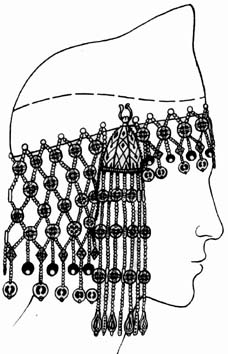
Fig 2
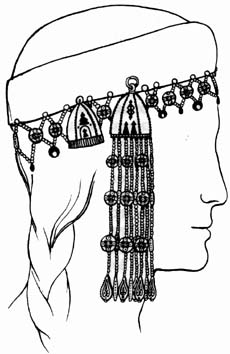
Fig 3
Some different examples of podniza:
Fig 1: The podniza appears to be sewn onto a band going
around the hat and appears to interchange between pearls and metal
discs.
Fig 2: Another example of a podniza interchanging
between pearls, discs of metal, and jewels. This is also a great
example of a podniza extending all the way around to create an almost
veil behind the head. This is also a headdress of a married woman.
Fig 3: Here is a maiden's headdress with a much shorter
podniza than the married woman's headdress, but it still goes all the
way around the back of the head.
All drawings copyright Julia Sepanova.
References
Kies,
Lisa. Women's Headdress in Early Rus.
http://shadow-cat.150m.com/Costume/rusheads.html
(April 3rd,
2011).
Pouncy, Carolyn Johnston. The Domostroi: Rules For
Russian Households in the Times Of Ivan the Terrible. Cornell
University Press: London. 1994.
Pushkareva, Natalia. Women in Russian History: From
the Tenth to the Twentieth Century. M. E. Sharpe: Armanok, NY.
1997.
Rostovskogo, MordakTimofei. Class Notes “The Practical
Clotheshorse Embroidered: 16th Century Russian Decorative
Stitchery and Pearling.” 1997.
Sepanov, Julia.
History of the Russian Traditional Suit.
http://archcostume.narod.ru/index.htm
(February-April 2011).
Subscribe to:
Posts (Atom)