Showing posts with label research. Show all posts

Sunday, March 1, 2020

Chiaretta di Fiore's Laurel

Chiaretta has been a good friend of mine since my first ever kingdom scroll assignment (her AoA) where I first met her as we sat beside each other displaying our arts in competition.

Kataryn Mercer, AoA

We became quick friends. When her Maunche came around, I was thrilled and humbled to be assigned that as well. Many will remember the Kataryn Mercer Maunche of extreme painting and colors.

Kataryn Mercer, Maunche

I watched her progress in her arts to a level that was beyond what I could fathom. Her Italian was impeccable and gorgeous. And from the instant she told me that she had me in her ICP for making her scroll, I began planning. Through two computer crashes and purchases, I have saved a file that always returns to my computer holding a smorgasbord of ideas for what I would do when she was given her writ and I was assigned her scroll.

Two months ago, I was given her assignment. And then two weeks later, while I had already been plotting, she announced she was given a writ and hoped I was ready to make her scroll. I was, of course, super relieved because it meant I could ask her a few questions that I had always wanted to ask people before I made their scroll such as... what size is most comfortable for you and does it need to be a standard scroll and format for standard framing, or do you mind possibly needing to do have a custom frame created.

All of this out of the way, I opened my folder to begin.

First, she and I had discussed years ago how amazing the Lace Book of Marie de' Medici was, but my biggest frustration was that it was, technically, out of period. It is described to be from the second quarter of the 17th century. But the idea behind the papercutting, or canivet, was not something so late of a period. Canivet, the idea of lace cutting paper, is a tradition seen since 13th century in France with the nuns, thought to be considered 'cloister work'.

Lace Book of Marie de' Medici, 17th century
But I truly loved the idea of a lace cut scroll, and although there are earlier examples such as this French example from the 14th century, it didn't have the same feel as I was looking for.

French Manuscript (W.93), 14th century
So I continued searching for the perfect lacework cut from parchment as a more period source.

And that was when I realized that Chiaretta did amazing accessories, so why not accessorize her scroll? I scoured museum sites until I found the perfect extent find to make the papercut lace with.  This fan is made of parchment and silk lace from the 16th century. A Venetian style flag fan. It was perfect for Chiaretta's Italian persona.

Italian flag fan, 16th century, parchment-cut lace design and silk
I loved the outer design work of the flag, and that is what I took as my inspiration for her scroll.

Now, I needed to order the perfect material. Paper, in my mind, would not cut it (haha, no pun intended). So, I spoke with my fellow scribal artists for where the best place to buy parchment/vellum would be. I knew, vaguely, the size I wanted to make the piece. So, through my searching, I found someone (a SCAdian) out in Oregon that hand crafted vellum in the medieval way and sold a variety of sizes. Here is a link to their Etsy shop. I highly recommend their product!

Parchment in hand with a measure of 16" x 13", it was time to get started. The first thing I did was get the pencil in on what I felt would be the 'back' of the piece. There was definitely a texture difference between the front and the back, and I felt I made the right choice. There were also a few other strange things about the parchment (coming from someone who usually just works on machine made papers) such as the change in coloration, the visibility of 'this was skin' marks, and the difference in the thickness (and textures) of various areas of the parchment. Do not misunderstand me. This FASCINATED me and made me feel, for the first time ever, as if I was working in a period manner. It wasn't this perfect flat simple piece of paper. I have been doing paper cutting for awhile, so this was going to truly test my mettle.

Either way, I was excited. I have worked on parchment before and knew what I was getting into with inks, pencils, and any form of 'mark' on the surface, but this was a whole new beast.

Pencil on goat skin vellum (parchment)

In hind sight, I realized putting so much detail into the pencil was unnecessary. I will explain more about the reasoning for this later, but I was glad I got the shapes done before putting the blade to the parchment. Then, I started cutting. I used a #11 blade and my most comfortable pen grip for it. It was severely difficult at first because everything about cutting parchment was different than cutting paper. The pressure needed, the draw needed, how it felt (the tooth and bite of blade and leather), how it looked, and even how it tore if only a few fibers still held the piece in place.

#11 blade and beginning cuts as viewed from the right side of the parchment

But, it wasn't terrible! It was just a very different learning curve. Thankfully, I had done enough paper cut work to have a good idea of what I was doing. I kept tape handy, just in case, and I think that my cutting board STILL has little scraps of tape stuck to it for when I would cut the most miniscule piece and rub it into place as the heat would eventually take to the fibers of the parchment and keep what I feared was a little oops from becoming something bigger. I learned, later, that there -were- no oopses because parchment acts so much different than paper.

The actual main portion of the lace work measured 2.5" in width with the thinner, minus the triangular flag portions, measured closer to 1.5". Each inch of work along the piece took over an hour to cut, leaving an estimation of about 80-85 hours of work for the cutting, not including the prep time. 6 blades were needed (as I have no strop at home) in order to finish the whole piece.


There are a few very specific things I learned while working on cutting the parchment.

  • Always always cut using a very dark mat underneath the cutting. My mat has two sides, one a light green and the other a very dark nearly black green. When I cut with the lighter, it was very difficult to tell where my cuts began or ended. When I flipped to the darker side, it was much easier to visualize what I was doing.
  • There were very thick and tough areas that felt more like thin layers of horn than the paper feel of the parchment. Those areas would have been beautiful to ink on, but were -terrible- for cutting. It was easier to very carefully and slowly puncture small holes in close succession to the other and 'snap' the piece that needed to be extracted out of the way.
  • There was quite a buckle in the parchment along one edge. This is NOT the fault of the person who made the piece and more just from the difference in temperatures and humidities of the two climates. I am certain, in medieval times, that the same was a problem as bundles of parchment were purchased or delivered from one local to another. Well, I found that cutting that area was an extremely difficult task due to the buckling and frustrated me like nothing I had ever known before. And yet, the next day when I returned to do more work, that area laid flat. This now causes me to agree at the sense it made that some manuscripts were known to have score lines from sharp blades for where the writing would be. Not only did it keep the writing line straight, but it helped to flatten the buckle if there was one so that writing could happen.
  • There were areas which didn't feel as tight as the rest of the parchment. Almost as if the fibers were a little loose and it made the area feel spongy. There was a bite to that area that, even with a brand new blade out of the box, I could feel it drawing through the fiber as if there were burrs on the blade. Although I tried to sharpen my blade, the bite still got the better of me. I powered through, though. It just made my wrist and elbow and shoulder ache. I never knew so much of my arm muscles would go into cutting! Addendum: This is NOT the parchment makers fault either. Skin is a fussy thing and there are areas that can be more callused than other areas just as they can be more fatty areas.
  • Do not wear anything on your arms! No, seriously. Everything wanted to catch. Even a watch or a ring. It is best to have clean arms, free of any hindrance and make certain your working space is LARGE LARGE LARGE! You don't want to feel the need to turn the piece and it catches on ANYTHING.
  • Thankfully, parchment is nothing like paper. Paper tears very easily and parchment, I found, has a lot more give to it. Even when accidentally slicing through a small section of lacework and perhaps cutting a tiny ring, I would try the tape maneuver, but these little slices did nothing. The parchment, for any better description, worked much like leather. Any cut did not mean a malformation of what I was working on. It remained stiff and in place. That doesn't mean I didn't want to be as careful as possible, simply that the way parchment worked and the way paper worked are two completely different beasts and it is important to fully grasp and understand the material and respect its properties.
  • Remember how I talked about marking all the detail work in pencil? Well, less is more when it comes to this craft. Specifically, less confusion into where there is a cut vs is that possibly a pencil line can save a LOT of grief on future endeavors.
As I mentioned earlier, I never felt like I was working in more period of a manner before. And although there were a few frustrations and difficulties, I thoroughly enjoyed the whole process! And yes, I still recommend the parchment from this maker. These spots are bound to happen, yet he did a tremendous job of keeping them towards the edge and making sure that the scribal middle area would give that amazing feel we all know and love when being worked with. I couldn't have asked for better unless I went for machine made, and that is not at all what I wanted with this project.

To keep with the theme and the time period, the words that were written for the scroll were based on lines from Aminta, a play written by Torquato Tasso in 1573, performed during a garden party in Northern Italy. Lines from the play were taken as inspiration by Olivia Baker, who wrote these words:


"Who often makes Mars' bloody sword drop from his hand,
while Neptune's mighty trident rattles to earth,
and even from highest Jove the eternal lightning slips!
It is she, our beloved and revered Chiaretta di Fiore.
She, who in the eternal serenity
Among celestial sapphires and beautiful crystals
Where summer never is, nor winter,
Leads perpetual dances
Of thread, fabric, and finesse swirling in harmony to conceive the divine.
For mortals dream to dance in the shadow of such beauty, such elegance, such perfection,
 As does adorn our Chiaretta's celestial frame.
Earthly words, there are naught worthy of her accomplishment.
And now here below immortal grace
And high fortune are seen in this beautiful image
Do I, Margarita, Great and Fearless Queen of these Eastern Lands,
yield further utterances and do induct this virtuoso of Florentine vestment into the Order of the Laurel.
Done this 29th day of February, Anno Societatus LIV, at Our Queen's and Crown's Arts & Sciences Championship in Our Barony of Dragonship Haven."

From there, my dear friend Vince Conway graciously translated the words into Italian for me:

"Chi spesso fa cadere da mano la spada sanguinosa di Marte,
 mentre il potente tridente di Nettuno scuote sulla terra
e persino dall'alto Giove l'eterno fulmine scivola!
È lei, la nostra amata e venerata Chiaretta di Fiore.
Lei, che nell'eterna serenità
Tra zaffiri celesti e bellissimi cristalli
Dove l'estate non c’è mai, né l'inverno,
Dirige balli perpetui
I mortali sognano di ballare all'ombra di tanta bellezza, tanta eleganza, tanta perfezione,
Così come adorna la cornice celeste della nostra Chiaretta
Ed ora qui sotto grazia immortale
E grande fortuna si vede in questa bellissima immagine
Io, Margarita, grande e impavida regina di queste terre orientali,
cedere ulteriori espressioni e indurre questo virtuoso del paramento fiorentino nell'Ordine dell'Alloro.
Fatto questo ventinovesimo giorno di febbraio, Anno Societatus LIV, presso la Campionato di Arti e Scienze de la nostra regina e corona nella nostra baronia di Dragonship Haven."

With the words prepared, I was then able to get to the writing. I had fallen in love with a master calligrapher's album in Germany and wanted to use that for my inspiration in the cadel/calligraphy department. In the later periods, many calligraphers would create 'sample books' of styles that they were able to replicate in hopes of drumming up business for various works. This was a similar type of book and I  just fell in love.

Werke der Schon Schreibmeister by FH Brechtel, 1573
I loved the gilded letters and I loved the stark black and gold of the cadel. Of course, there was also needing to delicately balance all the flourishes so that it didn't detract from the papercut lace. So I decided to focus on the gilding and less on the flourishes as I began working on the words. But first I had to design the cadel.

Pencil sketch to prepare for cadel drawn on scrap paper

Something simple with simple flourishes and making the curved spine so it would still be viewable as a letter C was important. It took a lot of work to create something that I felt fit the style of the period.

Cadel of the letter "C" complete with india black ink and Winsor & Newton gold

Words done in india black ink and Winsor & Newton gold

I was quite pleased with how both the lettering and the cadel came out. The ink used was a black India ink and the gold was Winsor & Newton brand. Both worked beautifully on the parchment. Space was left for the signature at the bottom. The cadel was made to fit in a 2" by 3" space and the letters were 1/8" high.

I wanted to keep with the feel of the Lace Book of Marie de' Medici, and one of the most fascinating things about it was how they painted over the patterned lace to make even more patterns, so I did the same with the lace work around the scroll, using the gold ink to help it take on a new quality.

Winsor & Newton gold ink embellishments

The last important part needed for a peerage scroll is the laurel wreath. And, since Chiaretta had recently changed her arms since the last time I painted them on her AoA, I wanted to add them as well. Thankfully, her arms lended very well to being done as a paper cut.

Chiaretta's arms
And, of course, adding the laurel leaves around the shield could -also- be done as a paper cut.

Pencil sketch on scrap paper 2.5" x 3" of arms and laurel wreath in preparation for cutting

After I cut it all out, gilding the shield with the gold ink fit perfectly into the feel of the rest of the scroll.

Cut arms and wreath with Winsor & Newton gold ink for the shield, outline in India black ink

In the end, the full scroll took over 100 hours of work of cutting, calligraphy, and gilding/painting. Of course, having delicate edges, I didn't want to cause a heart attack for the heralds, so I took a board, covered it with a deep blue cotton velveteen, and carefully pinned the scroll to the fabric so it would not have to be handled but could still easily be signed by the Queen. The final result was something I was incredibly proud of and drew me closer to feeling like I worked a medieval craft than anything I have ever done before.

Chiaretta di Fiore's Laurel Scroll, given on the 29th day of February and K&Q A&S competition

Tuesday, March 8, 2016

King and Queen's Bardic Champions

It is very important to me to start documenting my performances because I have been working so hard on all of them. I have been working hard on how to stand, how to talk, what to wear, what props to use, how to move, etc.

This past weekend, against previous decisions that my life had been too hectic, I decided that I would compete if for no other reason than to be given a venue in which to teach a little bit more about skomorokhi and what/how they did what they did.

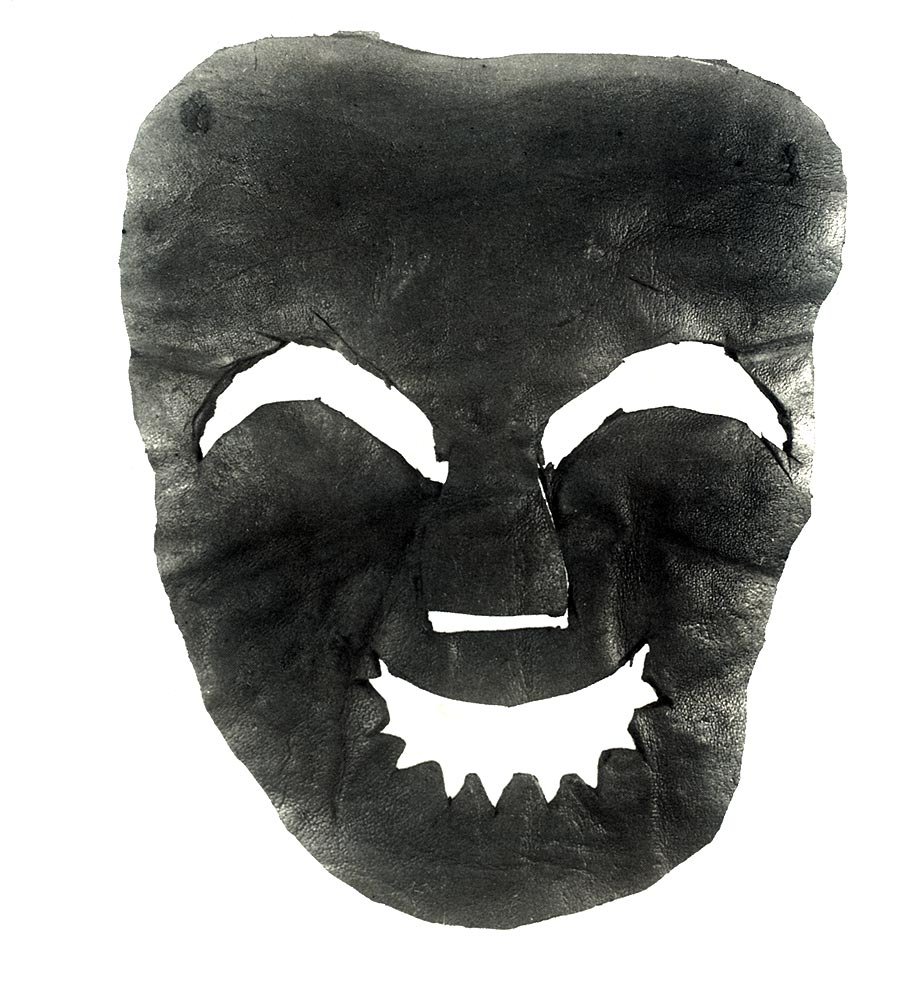
For the first round, I did a piece I call The Brave Youth. I decided to incorporate a lot of the movement I learned taking classes from Antonio Fava as well as an extant find mask I had been wanting to make for a long time.

Here is the 13th century 'buffoon' mask, made of leather and found under the floor boards of a cobbler's shop that was excavated.

And here is the mask that I made, using the same measurements as the mask above (16 x 13 centimeters).

The card I handed to the judges with the documentation for my performance read as follows:

"The Brave Youth
Katrusha Skomorokha Negodieva `Doch

Mask based on late 13th century extant find.

"The first known recording of a Russian folktale was made in the sixteenth century by an Italian historian."
"While the east slavic folktale flourished as entertainment ... folktales were enjoyed among all social classes, including the tsar's family."
Johns, Andreas. Baba Yaga. Peter Lang Publishing: New York. 2004. Page 49.

In 1905, an excavation revealed burial mounds of the 11th -12th centuries that bear a striking resemblance to the tales of Baba Yaga, giving us reasonable cause to believe the skomorokhi told the stories to keep the bodies from being disturbed."

Here are a few photos from the performance to show some of the acrobatics used. I geared the performance hoping for children to come forward and enjoy it. I will post a video of the performance once they are available.


My second round piece I had decided on taking excerpts from the Izbornik, a book written around 1076. My documentation for it read:

"Parental Advice
Katrusha Skomorokha Negodieva `Doch

Excerpts from the Izbornik, circa 1076.

"The majority of the people were largely unaffected by the conversion (to Christianity) ... they continued to practice the ancient cult of their ancestors and to call upon the skomorokhi for spiritual guidance."

Zguta, Russel. Russian Minstrels. University of Pennsylvania Press. 1978. Page 15."

Here is what I read:

"Child, in your lifetime test your soul and see what is bad for her and do not give it to her, for not everything agrees with everyone, not every soul enjoys everything. Entice your soul with gladness and comfort your heart, and remove sorrow far from you so that you will not grow old too soon.

Do not be ashamed to stand against the current of the river, or submit yourself to a fool, or court the face of the powerful, but defend truth to the death.

Do not withhold your mercy even from the dead and do not fail those who weep; mourn with those who mourn and do not shrink from visiting the sick, because for those deeds you will be loved. A sweet throat multiplies friends, and a fair speaking tongue multiplies courtesies.

Child, from your youth up choose instruction, and until you turn grey you will find wisdom. Come to her like one who plows and sows and wait for her good crop. In cultivating her you will toil a little while, yet soon you will be eating the good things of her produce. She seems utterly intractable to the uninstructed and the faint of heart will not remain with her but leave; for wisdom is like her name and is not revealed to many.

Put your feet in her fetters and into her collar your neck; put your shoulder under her and carry her, and let her bonds be not to close. Come to her with all your soul and keep her ways with all your might Search out and seek, and she will become known to you. When you get hold of her, you will not let her go, for in the end you will find her rest: she will be changed into joy for you and her fetters will become for you a strong protection and her collar a robe of glory, for upon her is the beauty of gold, and her bonds are a braid of precious stone. You will put her on as a robe of glory and put a crown of gladness on your head.

If you wish, child, you will be instructed, and if you give it your soul, you will become clever; if you love to listen, you will live, and if you incline your ear, you will become wise. Child, stand in the multitude of elders, and if one is wise, cleave to him. Be willing to listen to every narrative, and the precept of insight will not escape you. If you see a wise man, rise early to visit him and let your feet wear out his doorstep.

Above all, child, remember this. Do not hide your wisdom, for wisdom will be recognized by your word. Be firm in your mind, and let your word be one."

Although I did not make it into the third round, I decided that I would begin documenting my resume as well. So my resume was written as such:

Katrusha Skomorokha Negodieva `Doch

A War Song (not period) written by another
" ... foreign influences enabled the skomorokhi to transform themselves ..." page 21

Order of the Bedchamber (period style) praise poem for the King created on the spot
"Of the 188 persons listed under the general heading of the Order of the Bedchamber ... two were skomorokhi." page 54-55

Traditional Russian historical piece (period style)
" ... skomorokhi became heirs to a rich body of oral heroic poetry ..." page 22

Sing-a-long (not period)
"... on occasion Ivan himself (Ivan the Terrible) took part in their (the smokorokhi) entertainments." page 55.

Zguta, Russell. Russian Minstrels. University of Pennsylvania Press. 1978.


The only other thing to explain is the clothing style choice. Skomorokhi, having been nearly banished by the church, took on a lot of repertoire as well as clothing styles from their European counterparts. They took inspiration from anywhere they could get it: Germany, Italy, Greece, China, etc. So I fashioned my garb after these descriptions and the few illuminations we can find of skomorkhi. And yes, there were female skomorokhi.


Sunday, February 23, 2014

Cuidoient li losengier Linguistics


Cuidoient Phonetic Interpretation
by Katrusha Skomorokh


In my most recent language project, I focused on a song in French called 'Cuidoient li losengier'. The song was written by Guillebert de Berneville in the 13th Century and can be found in The Anthology of Music: Medieval Music, on page 73. The point of this project was to teach myself proper medieval French phonetics.

My fall back for learning any language is to use IPA (the International Phonetic Alphabet). It is something my mind can fully understand and using the knowledge from the descriptions of various phonemes, I am able to create the necessary sounds needed to produce the language as it was hopefully produced in the time period of Guillebert de Berneville.

The difficulty with this project, as with any project that comes to language, is that you will always have regional variants and discrepancies. As stated in Singing Early Music, “Conon de Bethune was embarrassed by the mockery by court people (even by the queen) of his regionalized Artois or Picard speech, and he claims in a poem that it is uncourtly to make fun of someone else's pronunciation.” In other words, our most useful guide to pronunciation through the ages is by looking at written text. The earlier the text, the more probable that all letters that are seen were meant to be pronounced. This created the issue (or perhaps the pleasant knowledge) that as the centuries came and went, it was usually the uneducated that would would continue to reflect the evolution of pronunciation. Just as children have a tendency to spell based on the sound instead of the actual proper spelling, uneducated people in the middle ages gave us hints as to the pronunciations while the educated told us the correct spellings.

We can also see a lot of influences of French in Middle English or Middle High German and vice versa. This can also help us to figure out pronunciations as well. Taking everything into consideration with this song, from what education the man who wrote it may have had to the region where he was located and the time period of the piece all helped me begin to learn what could have been the pronunciation of 'Cuidoient li losengier'.

To begin this research, I decided to work backwards. It is much easier to see how things would be pronounced now and start working through the language in that manner. Being completely clueless as to what French even sounds like (it was not my language of choice during my school years), I found I was in need of some help.

The first verse of the song reads as such:

Coidoient li losengier
Por ce se il ont menti
Que je me doie eslongnier
D'amors et de mon ami
E non Dieu, je l'amerai
Et bone amor servirai
Nuit et jor
Sans fere folor
Et g'iere envoisie
Chantant et jolie

I asked for a phonetic interpretation. Here in lies one of the biggest difficulties in language. Studying it is really an activity where you need to actively be listening. Spellings, dialect differences, and personal preference can all create problems for someone trying to work out pronunciations.

This is the phonetic translation that I was given:

kwee-dwah-ehnt lee loh-sehn-zjer
pohr keh she eel ohnt mehn-tee
keh zjuh meh dwah ehs-lwahn-zjehr
dah-mohrs eht deh mohn ah-mee
ah nohn deeoo zjeh lahm-ehr-ay
eht bohn ah-mor sehr-vee-ray
nooeet eht zjohr
sahns feh-reh foh-lohr
eh zjeehr-eh ehn-vwah-zee
shahn-tahnt eht zjoh-lee

In IPA, in my opinion, that would be written like this:

kwidwaɛnt li losɛnʤiɛɹ
pɔɹ keɪ seɪ il oʊnt mɛnti
keɪ ʤʌ mɛ dwa ɛslwaŋʤiɛɹ
damɔɹs ɛt dɛ mɔn ami
ɛ nɔn diʊ ʤɛ lamɛreɪ
ɛt bɔnɛ amɔɹ sɛɹviɛreɪ
nʊit ɛt ʤɔɹ
sans fɛɹɛ foʊlɔɹ
ɛ ʤiɛɹɛ ɛnvwazi
ʃantant ɛt ʤoʊli

This was my experiment of reading it out loud to myself before properly hearing what it sounded like. The biggest flaws in my first dry run is not having the nasalized vowels [ã, ɛ̃, ɔ̃, and æ̃] or the voiced uvular fricative [ʁ] which is much different from our voiced alveolar approximant [ɹ]. I sat down and listened to the pronunciation of this verse again as well as taking my French dictionary that has the pronunciations written in IPA, I was able to create a new written idea of how this would be pronounced in modern French. Unfortunately, many words were not in the dictionary as this is a Medieval poem and a lot of changes have happened in language since then, so I had to trust my friend's thoughtful pronunciation.

kwidwaɛ̃t li lɔzɛ̃ʒiʁ
pɔʁ sə sə il mɛ̃ti
kə ʒə mə dwa ɛslwãʒiʁ
damuʁz e də mɔ̃ ami
ø nɔ̃ djø ʒə lamɛʁe
e bɔ̃ɛ amuʁ sɛʁviʁe
nɥi e ʒɔʁ
sã feʁe fɔloʁ
ø ʒiʁe ãvwazi
ʃãtã e ʒɔli

Of course, I then began to wonder what, exactly, the medieval pronunciation of this song would be. An alphabet has two rules when it is created. Those rules are:

1. Each symbol should represent a sound.
2. No spoken sound should be represented by more than one symbol.

In those regards, that means that as language evolves, we get the confusion of multiple letters together creating a new sound, or even letters becoming silent depending on the words. The only way to figure out how this song would have been pronounced would be to start at the beginning of language (as close as we are able to study) and slowly move forward to the time and place where this particular song was created.

As questions began to arise, I began working side by side by side with the modern French dictionary, my text book from the International Phonetic Association, and a wonderful book called Singing Early Music that specifically looks at the changes of language using the International Phonetic Alphabet.

Where to start? Well, there are important things to look at. First, I searched for a visual of the actual manuscript, as there is a lot you can learn from looking at the actual piece. I also wanted to do some research on the author of the piece as well as the area he was from and any other little tidbits that would help me to learn more about how things would be pronounced.

I began by scrutinizing the manuscript while looking back and forth with the recent publication in a more modern musical notation. There is so much that can plausibly be lost in translation, so I wanted to make sure that I was able to view the actual source instead of just someone else's interpretation of the source. I am glad I did. There are various things I learned, all were were important, from viewing the manuscript.


-Space was, for some reason, limited, even though the song was laid out where new lines would just start wherever the word would fit. There is an interesting mix of omitting whole words (in the slight chorus-like refrain that is seen in 4 of the 5 verses), omitting letters (also in that chorus-like refrain), and squishing extra letters above the word in question to finish the word. It seems, often, like poor planning.

-The scribing, for that time period, was sloppy without proper kerning or straight lines for the letters.

-The authors signature was in the middle of the page between song lyrics. This could mean that this was a book passed around by various authors, perhaps even a book of the Puy d'Arras (which I will talk about later).

-I find it odd that the repeated section (that only differs, alone, in the second verse) starts, written in the music, as "et siere (it honestly looks like an s, not a g like all the others) envoisie. chantant et jolie." The second verse states "sen sui renvoisie chãtãt." which makes it look familiar to the modern IPA for the song. It then stops there with no symbol to mean 'continue the phrase' or anything. The third says "et giere envoisie." (fixed from the first ending) again ending with no further symbol. The fourth, "et giere." and then the last, "et giere envoisie chantant et jolie." returning us back to the original full phrasing.

-It is impossible, by viewing the manuscript by an amateur like me, to be able to tell rhyme scheme or meter of the piece. But I know that trouveres were very big on rhyme and meter, so the only way I was going to learn more about that was through IPA and looking at the Oxford Anthology printed edition of the song.

It was now time to begin looking at the difference between modern French and Medieval French. The biggest changes, of course, are between the alphabet actually being used to its full extent in Early French (remember the rules for an alphabet?) and certain phonemes either no longer being used or having been simplified by the time we get to modern French.


So, for example, let's look at the early French IPA translation possibility for the song (for, as Conon would say, there are regional varieties and we shouldn't make fun. But according to Singing Early Music, these rules were traditionally used through most of France) next to the Modern. The early French will be on the left, modern on the right.


kɥidɔjãnt li lɔsãnʤjɛr̥            kwidwaɛ̃t li lɔzɛ̃ʒiʁ
pɔr̥ ʦə sə il õnt mãnti            pɔʁ sə sə il ɔ̃ mɛ̃ti
kə ʤə mə dɔjɛslɔjɲjɛr̥             kə ʒə mə dwaslwãʒiʁ
dãmɔr̥s ɛt də mõn ãmi           damuʁz e də mɔ̃ ami
ɛ nõn djɛw ʤə lãmər̥ɛ            ø nɔ̃ djø ʒə lamɛʁe
ɛt bõnãmɔr̥ sɛr̥vir̥ɛ                e bɔ̃amuʁ sɛʁviʁe
nɥit ɛt ʤɔr̥                            nɥi e ʒɔʁ
sãns fɛr̥ɛ fɔlɔr̥                       sã feʁe fɔloʁ
ɛt ʤjɛrãnvɔjsiə                      ø ʒiʁãvwazi
ʧãntãnt ɛt ʤɔliə                  ʃãtãt e ʒɔli


What we are seeing here is that in early French, all letters were pronounced, unlike in modern French. There is also a difference in the [r̥] and the [ʁ]. The first is a voiceless alveolar tap or flap, much like the modern r's in Spanish. The later, a voiced uvular fricative, was not even introduced into French speech until the mid-sixteenth century, and even then it wasn't accepted into cultured speech (poetry, music, etc) until the end of the seventeenth century (Singing Early Music, pg 73). Most of the sounds are seen in both the early and modern French, though. It is in the vowels that the most changes happen through time.


But was this an early French song, teetering in the 13th century when a lot of changes happen in language? It is now time to answer some further questions. Early French is stated to go from 1100-1250, while middle French is stated to go from 1250-1450, so being in the century that sees a lot of change (which, of course, didn't happen in a year, but we can at least lean towards one graduation or the other based on spellings, life of the author, and where/what was going on at that time/place), it was time to broaden my research to more than just the linguistics of a single song.


As is stated in the book Singing Early Music, “...all were increasingly dominated from the end of the twelfth century by Francien, the language used by the royal court...” This helps us in being able to believe that troubadours of France who were seen in courts would, most likely, according to this and the words of Conon, be speaking the same dialect as the courts spoke. So although there is a possibility of dialect differences, we can feel fairly certain that this will not be a huge discrepancy for our troubadour in question.


Gillebert de Berneville is stated to have flourished between 1250-1280. He was a French trouvere that, in his time, was appreciated and popular. Despite this, his songs are only seen in a handful of chansonniers. Gillebert had contact with the a lot of prominent men around the area of Arras, close to his home of Berneville. He worked with many poets in the region and even competed (and had one poem crowned) in the Puy d'Arras.


The Puy d'Arras was a medieval poetical society in Arras that held competitions between trouveres in courtly love lyrics. The president, annually elected, presided over the competitions. Its favored style of poetry was the jeu parti, composed when one troubadour would present a questions and take it up in debate with another, each taking different sides.

The region of Arras was a huge culture center in France, especially for trouveres. Between the culture, the society of Puy d'Arras, and the important figures seen in Gillebert's life, he was certainly educated well enough that he would most likely be in the trending of where language was at that time, leaving us with the decision to use middle French. In fact, as in 1180 Arras became an important location for banking and trade, wool being of great importance since the 4th century, the entire area would be following language trends, for certain.

But the manuscript was not helping me learn a date. Gillebert flourished for 30 years, but that doesn't even mean that this was written during his years of flourishing The Oxford Anthology, though, has a bibliography under the musical bars. It says:

R 1287; Paris; Biblioteque de l'Arsenal, MS 5198, p. 145.


Whether this means the song was written in 1287 or the book was finished in 1287, I do not know. But we can work on the middle French and then view the differences between the two and use that to determine which we should be using. Once again, we will look at early French on the left and middle French on the right.


kɥidɔjãnt li lɔsãnʤjɛr̥             kɥidwɛãn li lɔzãnʒjɛr̥
pɔr̥ ʦə sə il õnt mãnti             pɔ sə sə i õn mãnti
kə ʤə mə dɔjɛslɔjɲjɛr̥              kə ʒə mə dwɛlwɛɲjɛr̥
dãmɔr̥s ɛt də mõn ãmi           dãmɔr̥ ɛ də mõ ãmi
ɛ nõn djɛw ʤə lãmər̥ɛ             ɛ nõ djø ʒə lãmər̥ɛ
ɛt bõnãmɔr̥ sɛr̥vir̥ɛ                  ɛ bõnãmɔr̥ sɛr̥vir̥ɛ
nɥit ɛt ʤɔr̥                             nɥi ɛ ʒɔr̥
sãns fɛr̥ɛ fɔlɔr̥                         sãn fɛr̥ɛ fɔlɔr̥
ɛt ʤjɛrãnvɔjsiə                        ɛ ʒjɛrãnvwɛsiə
ʧãntãnt ɛt ʤɔliə                    ʃãntãn ɛ ʤɔliə


So, how do we decide which is more likely? I go back to the original manuscript. That one small discrepancy that I spoke of where letters/words were omitted. The second verse states "sen sui renvoisie chãtãt”. It is obviously a quick handed manner of making sure people can still read the word. It could be that the symbols that look like ~'s above the a's could be tiny n's. But the one thing they are not able to get rid of are the t's. Perhaps because, in that time period, not all the t's would be pronounced which means, if you didn't write them, people would think it was a different word. Look at the English word 'sign'. If someone left out the 'g' because you can't hear it in there (as an uneducated person may), we have the word 'sin'. Completely different words with completely different meanings. This makes me lean towards the middle English for phonetic transcription.


Also, it is said in Singing Early Music that in early French, any time two vowels were next to each other, they were each pronounced separately. Many were starting to blend in middle French. Because of this, the only way for the song to have a measured meter is if it were in middle French.


I also took the opportunity to view other trouvere songs of the time period, both the examples in the book as well as a book of women troubadours of France. They also had similar spellings for words that earlier (and, of course, later period) did not concur with. This confirmed two things for me. One, that Gillebert was educated. And two, that Arras was strongly influenced, because of its culture and activity, by the changing languages making them well seated in middle French at that time.


Most of the changes were in silencing of letters or in the vowels. There wasn't much change in the actual consonants. There were certainly rules seen for middle French as far as how to pronounce words. Here is a quick notation on them, taken from the easily more explained versions in Singing Early Music:


-spellings do not reflect pronunciation
-simplified affricatives: [s], [ʃ], [ʒ]
-silent [s] seen before consonants and in final position
-loss of many final consonants
-c before an a, o, or u is pronounced [k]; before an e or i is pronounced [s]
-ch is pronounced [ʃ]
-g before an a, o, or u is pronounced [ɡ]; before an e or i is pronounced [ʒ]
-j is pronounced [ʒ]
-l at the beginning of a word or syllable is pronounced [l]; if followed by a consonant, even if in the next word, is pronounced [w]; if il or ill, pronounced [ʎ]
-n and m both are still pronounced after their nasalized vowels
-[ɲ] is pronounced much like the Spanish ñ and usually spelled gn or ign
-q or qu is pronounced [k]
-r is pronounced [r̥] much like in modern Spanish or Italian
-rr is pronounced as [r̥] with a single tap only in speech, having not been accepted in song as such until mid 17th C.
-all final consonants disappeared in popular language, but in literary (song and poetry), the situation was complex. Inside a line of verse, s was only pronounced if the following word began with a vowel and it was voiced: [z]. At a pause or end of the line a final s was fully pronounced [s]. Inside a word s was always silent even though it remained in spellings until 18th C. Before disappearing, s was pronounced in an aspirated form [x] before transforming into a lengthening of vowel form. (To me, I am hearing... s is forever and always silent when followed by a consonant unless it ended a word or began a word. It certainly confuses me quite a bit, that's for certain.)
-x was used commonly for -us which was usually pronounced as [ws]
-z is pronounced [s]

There are also many rules for the vowels because, as I mentioned, they were starting to muddle and flow together at that point. I recommend picking up the book to learn more in that aspect as it is much too much to describe here.

It wasn't until after I had finished all the IPA for the song that I learned two incredibly important things that will help in learning the music and singing the piece.

-The rhyme scheme is a/b/a/b/c/c/d/d/e/e

-The meter scheme is 7/7/7/7/7/7/3/5/6/6

With that new knowledge, I was able to use IPA to finish the rest of the song.


(Please click on pictures to make them larger.)

Here I have rewritten the manuscript in IPA and it wasn't until I placed the musical notes on the staff did the music finally make sense to me. It is because in IPA I am able to see and know where the syllable breaks are that, looking at the actual language, I have no idea. For example, I always know the fourth syllable gets a three trilled note on one of the lines while all the other syllables in that line only get a single note. It does not mean that they are all whole notes or half notes. Just that each syllable is a mono - tone instead of a poly - tone. Being able to visualize all the breaks in the words is very helpful as I have, many times, tried to sing songs before where you can never figure out where syllables are to be placed according to the notes or even how many syllables a word has to be able to place them to the notes.

Here is the consonant chart along with the diagram of sound creation within the head. This chart shows all the consonant sounds that will be seen and used in Middle French. Of course, we can't say for certain that this is true without a doubt as we do now know that people made fun of accents of those in the same country. You will notice that all the consonants stay within the mouth, especially closer to the front. The closer we get towards modern French, the more we see a lot of the sounds moving uvular, more towards the back of the throat.

Here on the vowel chart, we can see the triangle formed by the various vowels in the mouth. The diagram at the top shows us the frontal closed sound of [i] which is pronounced like the sound in 'bee'. In the upper back of the mouth, still closed, we have the sound [u] like in the word 'too'. Our palate then rises as out tongue drops, mouth opening, and we find ourself with the more open [a] sound pronounced like 'baa'. All the vowels we will find, with the exception of those that have the [~] mark which makes them nasalized, all our vowels are going to be voiced within this small triangle formed in the mouth. Where you see the [e] next to the [y] sound, the only difference is that when we say [e], our lips are usually spread wide. If we round our lips into a more circular shape, we produce the sound [y]. You may not hear it right away, but that is because we are not always able to hear or pronounce phonemes that we do not use growing up: they leave our vocabulary, so to speak. Typically when two symbols are beside each other, though, you can experiment with the sound that on the left is more open and wide, and on the right is more rounded and tight.

When we look at modern French, we find more of our vowels becoming nasalized and pushing more towards the back of the throat, forcing the triangle seen here to change shape and location in the mouth.

With all this knowledge one can more confidently be able to pronounce words as they may have been pronounced in the past, being able to create the music with more of a period feel than we often can with our more modern learning.

I know that my research here really forces people to have a deeper knowledge of IPA (International Phonetic Alphabet) than many possibly may already have, so I would like to refer people to my starter course on IPA that I created, trying to keep the information in layman's terms in hopes that reading that will help teach someone enough that they can begin to understand more of what I am doing with my language research. Please view that handout here.


Bibliography

McGee, Timothy J., A. G. Rigg and David N. Klausner, eds. Singing Early Music: The Pronunciation of European Languages in the Late Middle Ages and Renaissance. Bloomington: Indiana UP, 1996.


Berneville, Guillebert de. “Cuidoient li losengier.” The Oxford Anthology of Music: Medieval Music. Ed. W Thomas Marrocco and Nicholas Sandon. Oxford: University Press. 1977. 73.

Handbook of International Phonetic Association: A Guide to the Use of the International Phonetic Alphabet. Cambridge: University Press. 1999. 78-81.

Bogin, Meg. The Women Troubadours. New York: W. W. Norton & Company. 1976.

Barron's French – English Dictionary. United States: Barron's Educational Series, Inc. 2006.

Theodore Karp. "Gillebert de Berneville" Grove Music Online. Oxford Music Online. Oxford University Press, accessed 8 January 2013.

Puy d'Arras http://en.wikipedia.org/wiki/Puy_d%27Arras accessed 14 February, 2014.